AI

AI-enabled tools deliver faster radiology reads, clinical decision-support, personalized treatment insights and continuous patient monitoring, but a new report from Firefinch Software and IMed Consultancy advises device developers how to enter and stay in this rapidly growing market.

Google spinout Verily has raised $300m to advance its AI-driven personalized healthcare platforms and become an independent company.

In an effort to streamline AI rules for high-risk systems and improve competitiveness, two European Parliament committees agreed amendments to the EU AI Act that will allow medtech companies to avoid double certification with notified bodies. A plenary vote takes place in late March.

South Korea starts development of AI-supported system to dramatically shorten drug approval reviews and announces new national strategy for AI in biopharma targeting 10x expansion in the country’s new drug pipeline.

Having got several pill versions of semaglutide approved, the Danish firm is tapping into external innovation to identify the next generation of oral therapeutics.

The latest annual UK ABHI survey of medtech industry sentiment on market access, regulatory hurdles and pathways for innovation reveals polarized views and levels of frustration among manufacturers who face ever higher compliance workloads.

With EU MDR/IVDR review proposals out, UK MHRA progress on a premarket regulation and, up ahead, a prospective consultation on accepting the CE marking indefinitely, now is a good time to assess EU-UK regulatory positions for the benefit of UK industry, says ABHI director Steve Lee.
Given its already large cancer drug pipeline, EVP of oncology R&D Susan Galbraith spoke with Scrip about how AstraZeneca is making precise choices about deals and development programs.
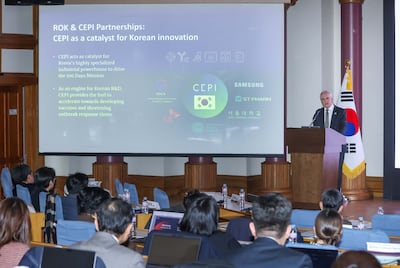
At a recent discussion in South Korea, CEPI and other participants explored ways to discover new health cooperation models that go beyond traditional aid approaches and to strengthen Korea’s role.

Among the Chinese AI firms raising new funding, Deep Intelligent Pharma has bagged a total of $110m in two rounds of funding since last December, while Levinthal, OxTium and Aureka have also closed new investment rounds.

Sunshine Pharma plans to invest at least $14m to set up a joint venture with fellow Chinese firm XtalPi, with goals including the discovery and development of novel molecules for autoimmune disorders.

AI promises to be the much-needed solution to the now overly complex field of EU medtech regulatory affairs. Will every stakeholder start using solutions such as Raiana?