

Long of interest to the medical device sector, real-world evidence (RWE) is coming into its own – especially with the US Food and Drug Administration. Not only do newly in effect guidance documents provide detailed recommendations on use of RWE in device submissions, but representatives from the agency and industry have been grappling with what RWE benchmarks should be included in the upcoming medical device user fee agreement (MDUFA VI).
Key Takeaways
- Real-world evidence is moving into the FDA mainstream. New guidance and ongoing MDUFA VI discussions signal that RWE is no longer experimental but increasingly accepted in device development and review.
- The National Evaluation System for Health Technology has emerged as a central RWE facilitator. Backed by an FDA grant to the Medical Device Innovation Consortium, NEST helps sponsors identify credible real-world data sources, develop RWE strategies, and navigate regulatory interactions.
- FDA alignment on RWE standards is improving but uneven. While interest in RWE is widespread across the agency, expectations still vary by office and risk profile—making early, frequent reviewer engagement critical to success.
And public-private partnership, the Medical Device Innovation Consortium, as well as its program the National Evaluation System for Health Technology (NEST), stands ready to help companies make their use of RWE as effective and efficient as possible.
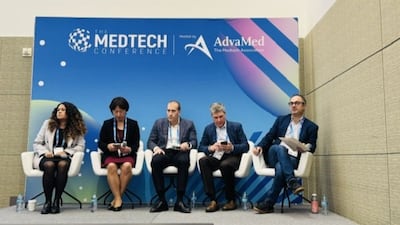
That’s the message MDIC president and CEO Andy Fish and NEST president Simon Mason conveyed during a recent conversation with Medtech Insight.
NEST, which launched in 2016, is funded through an FDA grant to MDIC and offers services aimed at bringing together sources of real-world data (RWD) and sponsors of health technology research to advance the quality of RWE for use in device submissions. In addition to regulators and the device industry, participating groups include data providers, market research organizations and scientific research groups.
Fish speculated that the growing prominence of RWE is tied to genuine progress in the area – including accessible technology such as remote monitoring tools as well as NEST initiatives.
“There’s a real shift underway at CDRH and with the whole medical device ecosystem, to better understand how to find real-world data, assess its reliability, figure out how to credibly convert real world data into real world evidence, and then interact with regulators in a way that gives regulators confidence that they can rely on that information, whether it’s as adjunct to or part of the data that’s considered for submission,” he said, noting that in some cases devices have won regulatory clearance based on RWE alone.
NEST’s role in this, he said, is developing public resources, such as a framework on assessing the quality of RWD and one on developing RWE from RWD. The program also works with individual sponsors to help them use RWE to support their submission, such as by helping them select real-world data sources and plan how to present it to the agency.
Patient Impact Key Factor
Three key factors stand out in helping NEST select individual companies to shepherd through the regulatory process, Mason explained. First, the organization wants to work with all of the offices within the FDA’s device center, meaning it’s looking for devices serving a range of therapeutic indications. Second, NEST prioritizes companies that bring something unique to the clearance process, such as a new study methodology or a new data source.
But the most important single factor in selecting a company is patient impact, he said.
“We take on projects that have significant impact in that space,” Mason explained. “For example, pediatric off-label use, where we can help to move a product on-label. That largely wouldn’t happen through traditional processes with clinical trials.” It’s difficult to do clinical trials involving children due to a small population, ethical concerns and parental hesitation, so documented outcomes from off-label use can fill an important information gap.
In one representative case, NEST is working with NeuroPace to get the company’s electrical stimulator for treatment-resistant epilepsy cleared for use in children in the US. While it’s been implanted in some pediatric patients off-label, official approval has been slow due to challenging trial design.
“The company has been trying to get a trial off the ground in the pediatric space, but the criteria that has been suggested to them, they’re never going to enroll,” he explained. “So,using the off-label use as real-world evidence means that the company is probably going to be able to get this product approved where it wouldn’t have been able to do it through traditional methods. FDA is on board with the concept.”
The company is also working with an obstetrics device firm that is developing a product to help in the birthing process. But while the tool is on the market in Europe, population differences have historically made European trial data a tough sell to the FDA. Real-world outcomes from Europe, when combined with data gathered in small US trials, could help get the product over the finish line, Mason said.
Once a NEST client has been selected, the organization works to facilitate presubmission meetings and other discussions between the company and the FDA.
“FDA understands that, because it’s a NEST project, there’s something special about this one, that it’s not just a traditional approach,” Mason said. “It gets executives aware of it, so that helps to support the process.”
Alignment Still Work In Progress
However, getting the FDA fully aligned on RWE is still a work in progress. Various offices and individual reviewers within the agency are “aligned in their interest in being aligned,” Mason said, but still disagree on the specifics. For example, individual offices might have different standards for how much data is needed to support a submission, in part due to the vastly different levels of risk between them.
“The more we touch the reviewers in the process, the more that they start to learn, and the more they get involved, and more they get excited about this.”
Simon Mason“There are really distinctions that need to be made between the different areas,” Mason said. “And what I would say is that the more we touch the reviewers in the process, the more that they start to learn, and the more they get involved, and more they get excited about this.”
NEST is also working to certify data sources to ensure the RWD that is available to device firms meets FDA standards. Some data vendors were initially reluctant to participate because standardization can take away potential unique selling points, Mason said. However, device firms are now asking potential sources whether they’ve been certified by NEST, leading to an uptick in interest from data brokers.
“We’re seeing the data providers be more and more interested in participating so that they can get onto the playing field and have a conversation,” Mason said.
Fish seconded that view. NEST has become, he said, “perhaps the center of gravity in medtech real world evidence.”
“So increasingly, everybody that’s out there in this real-world data, real-world evidence ecosystem is recognizing that and participating,” he said. “Coming to NEST, whether it’s to get your data source NEST marked or otherwise participate in some fashion, is the place to be.”