
Legislation

Industry continues to oppose domestic manufacturing incentives that the FDA wants to include in the PDUFA reauthorization.

Including OTC studies in special protocol assessments will be addressed in FDA guidance required in 15 months on improving predictability of process and standards for approval of OTC drug applications, while stepwise labeling information will be post online to improve visibility and searchability fo

OMUFA reauthorization and directions for FDA to provide reports on monograph program and guidance on improving chances for OTC switch applications included in recent stopgap spending bill to end federal government shutdown.

But the Senate’s reduction would not be as much as the House of Representatives and President Trump proposed earlier this year, which is likely a win for the agency.

Limits so effective that states are relaxing restrictions they previously set exceeding the nationwide limit Congress imposed in Combat Meth Act in 2006 on the amount of PSE, as well as a second meth precursor, ephedrine, in OTC drugs consumers can purchase daily.

OMUFA reauthorization bill including amendment with sunscreen regulation provisions passed by Senate committee, which also approved other provisions not included in House OMUFA bill.

As stakeholders and lawmakers pin their hopes on OMUFA reauthorization as a vehicle for enacting sunscreen regulatory changes, Senate version of the bill could be the ticket after a sunscreen-specific amendment withdrawn in the House.
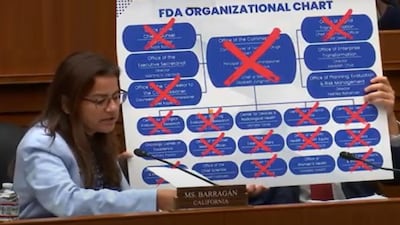
“We cannot ignore how Trump has taken a sledgehammer to the FDA ability to evaluate new drugs,” says California’s Nanette Diaz Barragán of California during Energy and Comme e markup discussion of five-year reauthorization of FDA’s OMUFA.

What's going on with the EU Green Claims Directive? HBW Insight speaks to the European Commission, Parliament and Council to find out why trilogue negotiations seem to have stalled.

Senate appropriators also put FDA on notice regarding recent meetings and compliance with the Federal Advisory Committees Act, signal positive news on rare pediatric diseases, and offer hints of other agency areas they have close eyes on.

Texas Democrat Lizzie Fletcher didn’t pose questions for witnesses at House Health Subcommittee hearing but used her floor time to question whether Congress will keep federal agencies afloat. “I have real concerns that even if we reauthorize these programs, we won't have the funding or the staff to

Subcommittee members aren’t on same page about whether FDA staff cuts ordered by the Trump administration will prevent the agency from fulfilling its responsibilities for the OTC drug sector.

Market growth and product innovations are continuing as FDA looks to Congress for authorization to establish regulatory pathway agency says it needs to determine whether to allow hemp-derived ingredients in food, dietary supplements and non-drug topicals including cosmetics.

A US House bill would give the FDA $33.1m more in budget authority than requested by the Trump Administration for fiscal year 2026. The measure was sent to the full House Appropriations committee on a party-line vote.

The EU Council has introduced a key amendment to Article 51 (para 1, point e) of the new pharma directive: “A medicinal product shall be subject to medical prescription where it is an antimicrobial, unless intended for topical use.”

HELP members state frustration with layoffs at FDA and pose questions about topics from generic drug approvals to OTC switches, and from manufacturing location labeling to whether the federal agencies intrude on US consumers. Still, acting CDER director Jacqueline Corrigan-Curay makes clear the resu

If the European Commission is serious about improving the competitiveness of the European Union, it should ditch the idea of making commonly used OTC antimicrobials like thrush treatments and cold sore creams prescription-only, warns Greek Medicines Agency president Evangelos Manolopoulos

AESGP president Jonathan Workman opens the 61st Annual Meeting with calls for industry unity in the face of the problematic revised EU Urban Wastewater Treatment Directive.
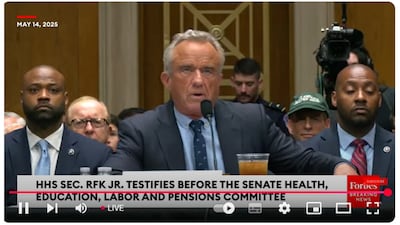
Health and Human Services Secretary Robert F. Kennedy Jr. emphasized administrative cost reductions and defended budget decisions during a Senate hearing on HHS funding. Some senators, however, expressed concerns over the impacts spending cuts had on essential health programs.

HBW Insight catches up with UK OTC industry association CEO Michelle Riddalls to talk about digital self-care and the unrealized promise of Brexit - part 2.